Feeling like your ultrafiltration and diafiltration just never go fast enough? It might be the pump — not the membrane.
Why the four-diaphragm pump is the perfect match for your UF/DF process.
When people think of ultrafiltration, the membrane is usually the first thing that comes to mind — pore size, membrane area, membrane material. But here's a fact many overlook: the membrane is just the “filter.” It's the pump that actually moves the fluid and sets the tempo of your entire system.
Think of it this way: the membrane is like a toll booth on a highway — it decides which vehicles get through and which don't. The pump, on the other hand, is the traffic flow itself. Steady traffic at a uniform speed keeps the toll booth running efficiently; erratic traffic jams it up.
The impact of a pump on UF/DF mainly shows up in three ways:
🌀 The Pulsation Culprit
Every time the pump strokes and pauses, TMP (transmembrane pressure) swings up and down. The concentration polarization layer on the membrane surface gets compressed one moment and swells back up the next. That instability accelerates membrane fouling — and your flux drops fast.
💥 The Shear Culprit
Some pumps — peristaltic pumps, for example — move fluid by squeezing the tubing. The liquid gets literally kneaded inside the pump, generating high shear. Fragile biomolecules like proteins and viruses can denature or aggregate under too much shear — not only clogging the membrane, but potentially ruining your product.
🎯 The Accuracy Culprit
Diafiltration lives or dies on diavolume: how much buffer to add, how far to concentrate — it all rides on pump flow accuracy. If the pump is off, your diavolume is off. Either you waste buffer, or your buffer exchange is incomplete.
The UF pump market offers no shortage of options, each with its own temperament. Here's a look at the most common types:
Table 1 Comparison of Common UF Pump Types (for reference only)
Pump Type | Pulsation | Shear | Accuracy | Dead Leg / Hold-up | Typical Application |
Four-diaphragm pump | Very low (90°phase) | Very low | High (±0.5%) | Low | Biologics, UF/DF, high-conc. |
Peristaltic pump | High | High (10–20×) | Medium | Low | Low-viscosity, small flow, sterile sampling |
Gear pump | Medium | Medium-high | Medium | Medium | General chemical transfer |
Centrifugal pump | Medium | High | Low | Medium | Large flow, low head |
Piston pump | High | Medium | High | High | High pressure, small flow |
Now you might ask: if the four-diaphragm pump is so good, why doesn't everyone use one? Well — it mostly comes down to cost and awareness. But if your samples are fragile, flux stability is critical, or you run frequent high-concentration concentration steps, the extra investment is very likely worth it.
So what exactly makes the four-diaphragm pump so special? Let's break down its core advantages.
A four-diaphragm pump has four diaphragms acting like four relay runners, each starting exactly 90° out of phase. Before the first runner slows down, the second is already accelerating to take over; before the second finishes, the third has already started. The four diaphragms hand off so seamlessly that the resulting flow is essentially flat.
Less pulsation means a steadier TMP; a steady TMP keeps the concentration polarization layer in a stable state; a stable polarization layer slows membrane fouling — and slows flux decline. If you know, you know.
Anyone working in process development knows the best feeling is “I set it, it delivers.” The four-diaphragm pump excels here.
Because the displacement per revolution is fixed and barely affected by pressure or viscosity, flow rate and speed have a perfect linear relationship — double the speed, double the flow, no ambiguity.
Figure 1 Example of the linear flow-rate vs. speed relationship (using a leading brand's model 100 as an example)
Late in ultrafiltration, the feed gets more concentrated, membrane resistance climbs, and system pressure keeps rising. That's when many pumps start to stumble — as pressure goes up, flow goes down.
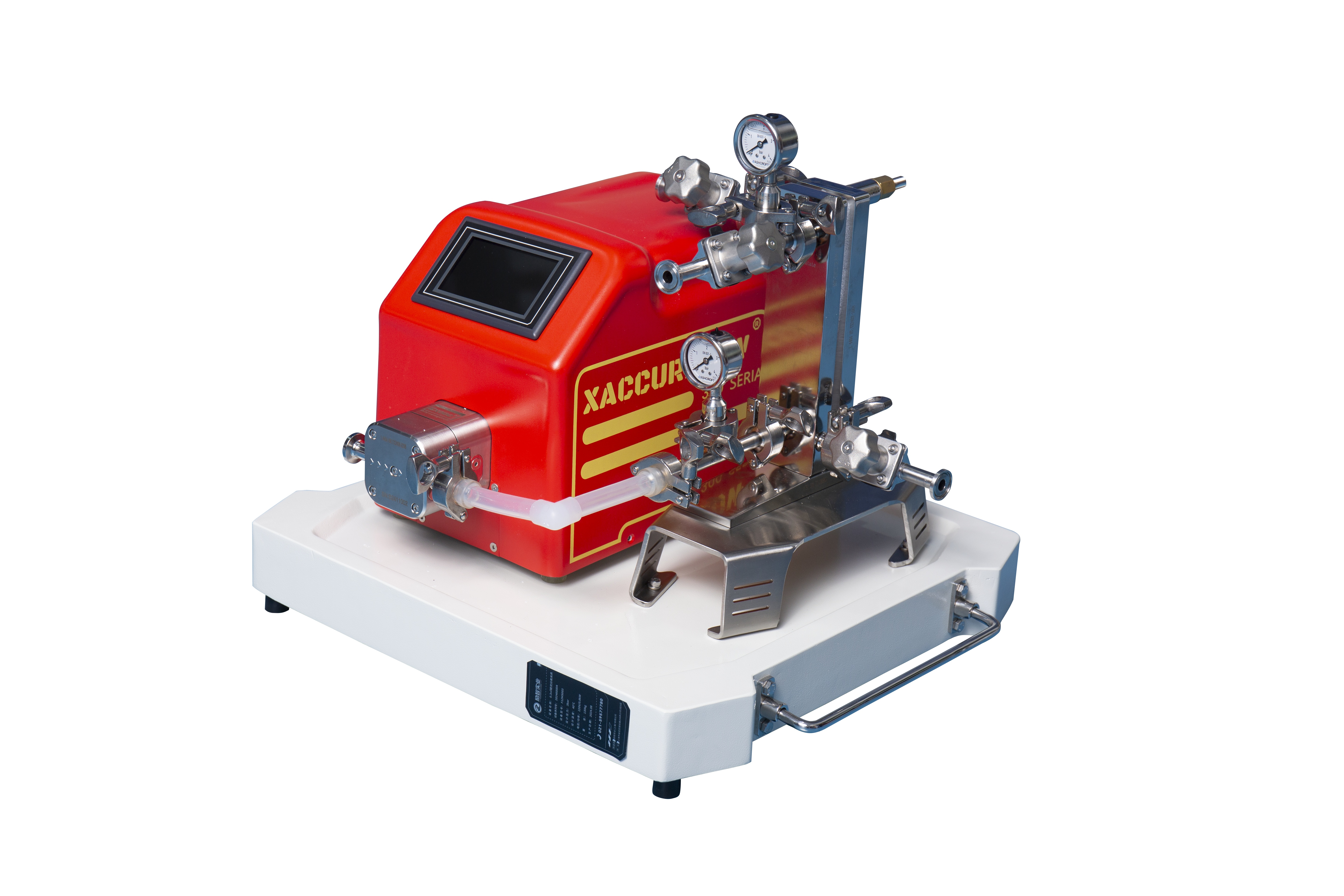
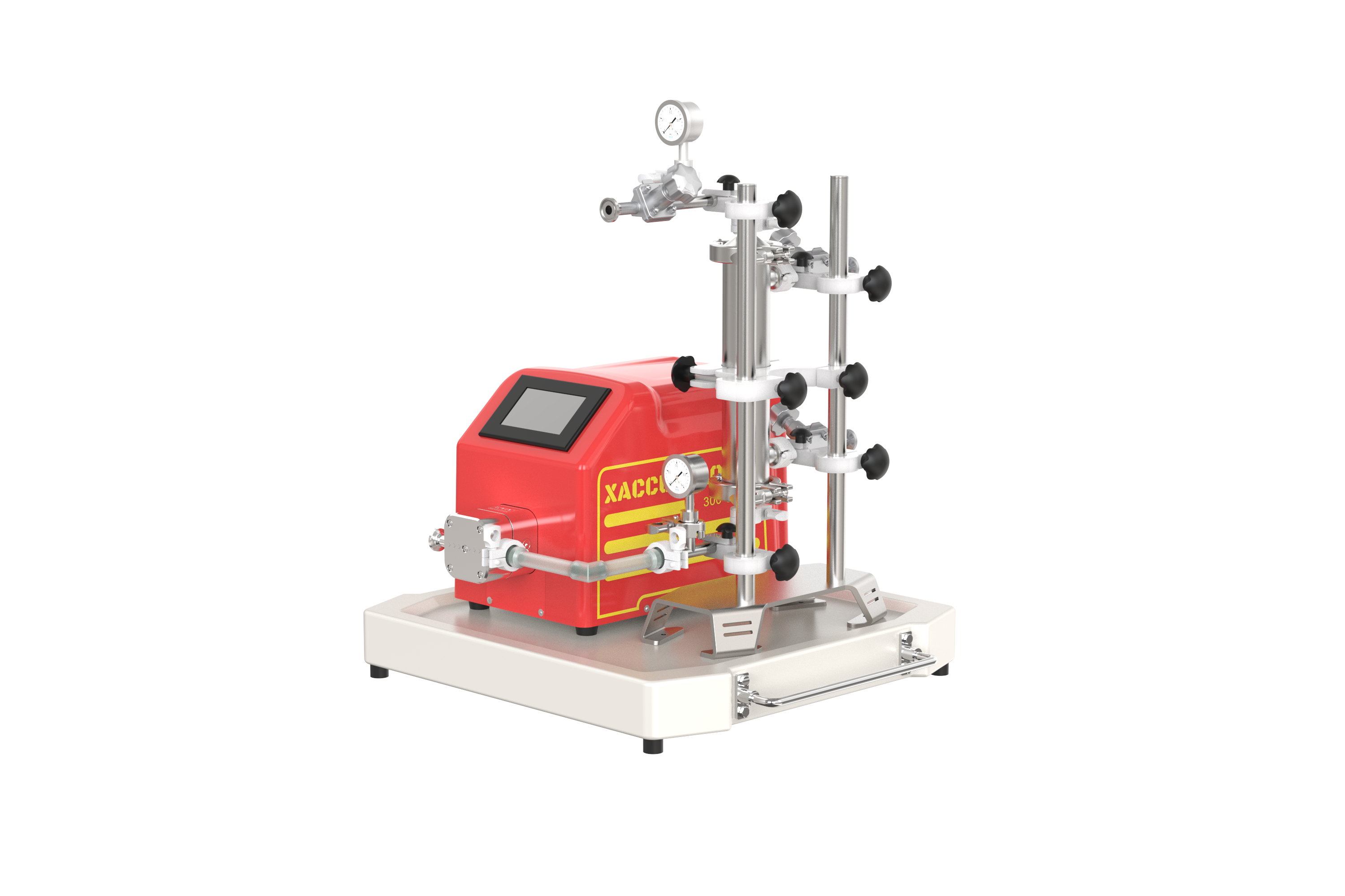
The four-diaphragm pump holds firm in this regard. Take the Exodc® XAccurflow® series from Lixi Industrial: it handles up to 6 bar operating pressure and still retains 75%–80% of its flow at 6 bar. In the high-concentration concentration stage, when other pumps are already struggling, it keeps pushing the feed through, steady as ever.
Peristaltic pumps move fluid by squeezing tubing with rollers. Just how high is their shear? Research suggests peristaltic pumps generate a shear rate 10–20× higher than low-shear pumps.
The four-diaphragm pump, by contrast, pushes fluid via the reciprocating motion of flexible diaphragms. There's no impeller, no gear, no mechanical part churning in the liquid. The fluid path and mechanical components are completely isolated — keeping shear to a minimum.
For fragile biological samples — proteins, antibodies, viral vectors — what does low shear mean? Less denaturation, less aggregation, higher recovery, fewer aggregate impurities. In short: your sample deserves to be handled gently.
All these technical details aside, you might ask: what does this actually mean for my runs? Great question. Here's the rundown:
⏱️ Faster Diafiltration
With slower flux decline, the whole diafiltration runs more efficiently. Same membrane area, same sample — you might finish half an hour earlier.
📊 More Consistent Results
Stable TMP and accurate flow translate to much better batch-to-batch consistency. No more scratching your head over “why is this run so different from the last one?”
💎 Higher Product Recovery
Low shear protects your sample and reduces denaturation and aggregation. Membrane fouling also slows, so protein is less likely to get trapped in the membrane.
🧪 Accurate Diavolume
Flow accuracy of ±0.5% lets you budget buffer precisely. No waste, no incomplete exchange.
🔧 Longer Membrane Life
A stable TMP plus low shear reduces membrane “fatigue” and fouling — so your membranes last longer.
🧼 Easier Maintenance
No mechanical shaft seals means zero leakage and zero particle shedding. CIP/SIP compatible, so cleaning and sterilization are straightforward.
If the four-diaphragm pump has caught your attention, the next question is: which model? Here's a simple reference:
Table 2 Flow Rate Reference for Different Application Scales
Application Scale | Typical Feed Volume | Recommended Flow Range | Membrane Area Ref. | Notes |
Lab R&D | 0.1–10 L | 0.3–20 L/h | 0.01–0.1 m² | Small volume, high precision |
Pilot | 10–500 L | 20–500 L/h | 0.1–1 m² | Scale-up, linear verification |
Production | 500 L–10 m³+ | 500–10,000 L/h | 1–10 m²+ | Large-scale, continuous operation |
Of course, final selection depends on your process parameters — feed viscosity, target concentration factor, operating pressure, and so on. The best approach is to talk with your supplier and let them recommend based on your actual process.
UF/DF is a systems challenge — membrane, pump, tubing, operating parameters; every link affects the final result. But among all the variables, the pump is often the most underestimated — and the one that makes the biggest difference when you change it.
If you're struggling with rapid flux decline, low recovery, or poor batch-to-batch consistency, give the four-diaphragm pump a serious look. It may not be the cheapest option, but over the long run — in process stability and product quality — it's often the best value.
After all, in bioprocessing, your sample is the most expensive thing on the line.
— Product Reference —
The parameters and performance data mentioned here refer primarily to the Exodc® XAccurflow® series four-diaphragm pump from Lixi Industrial (Shanghai) Co., Ltd. The series covers a flow range of 0.3–10,000 L/h, flow accuracy comparable to mass flow meters, a maximum operating pressure of 6 bar, CIP/SIP compatibility, and wetted materials compliant with USP Class VI, FDA 21 CFR 177.2600, and related standards.
Interested readers are welcome to learn more. That said, other brands of four-diaphragm pumps exist on the market — we recommend comparing options based on your actual needs to find the best fit.
上一个
下一个
在线留言