Search
×
E-mail

The "Zero Dead-Leg Guardian" at Point-of-Use: Why the Xmate Valve T-Type Diaphragm Valve Wins for Pharma Water Systems


Lizhi Industry · Exodc® Fluid Management

Xmate Valve T-Type Diaphragm Valve · Biopharma Water System Applications


The point-of-use (POU) outlet of a purified water (PW) or water-for-injection (WFI) system is where monitoring and sampling meet actual process use. The valve you choose here shapes dead-leg control, sampling representativeness, and the long-term microbial risk of your entire system.

The traditional U-bend plus 2-way diaphragm valve may technically meet ASME BPE's L/d ≤ 2 requirement—but with multiple welds, low-flow pockets, and stagnant zones, even 1.4435 material can't fully offset the hold-up and red-rust control challenges. The Lizhi Industry Xmate Valve T-Type diaphragm valve is a forged block-valve, zero-dead-leg solution that gives POU sampling points a more reliable foundation.

01  The U-Bend Approach: Two Hidden Risks of Dead Legs and Stagnation

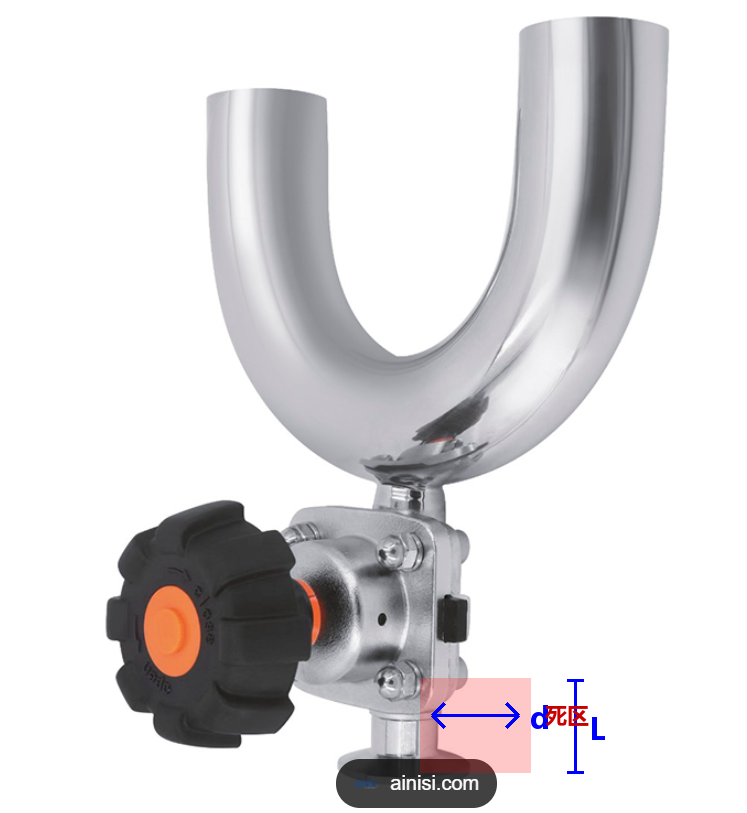
The U-bend setup uses a U-shaped recirculation bypass, with a 2-way valve at the bottom of the U and a sample port below the valve. This design carries two stagnation risks:

· First, the low-velocity pocket at the bottom of the U. The dip in the U-bend runs slower than the main line, creating a mild hold-up zone where biofilms can take root.


· Second, the sample-leg dead leg downstream of the valve. When the valve closes, the short tube between the valve seat and the sample port end (length L, inner diameter d) sits outside the recirculation loop—a textbook dead leg where microbes thrive.

Stagnant water that flushes out first during sampling can inflate microbial counts (false positives) and trigger OOS investigations. For ambient systems, the microbial contamination risk rises accordingly (ISPE Baseline Guide Vol. 4).

  U型隔膜阀.png                                                          

Figure 1  U-bend + 2-way diaphragm valve configuration (L = dead-leg length, d = sample-leg inner diameter, shaded area = dead zone)

02  The T-Type Zero Dead-Leg Design: Eliminating Hold-Up at the Source

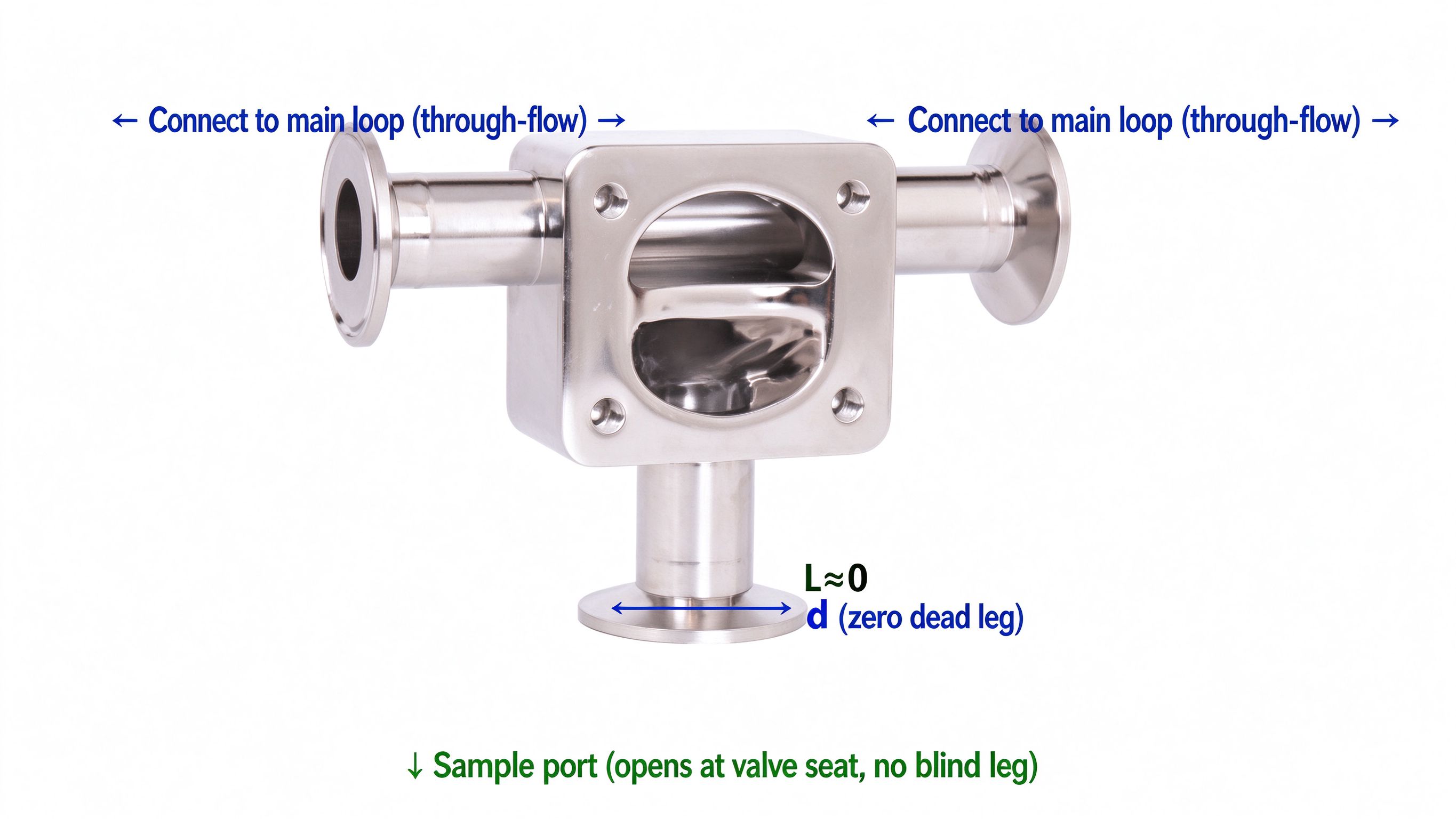
The Xmate Valve T-Type diaphragm valve is a one-piece forged 3-way block valve installed inline on the main loop. The main pipe breaks at the valve; the left and right ports connect to the two main-run sections. Flow passes straight through the valve body for recirculation, while the sample port opens directly at the valve seat.

Forged. Block valve. Zero dead leg. A single-piece forged stainless steel body means a compact structure with minimal hold-up volume. When the valve closes, the diaphragm seals directly against the sample port—the blind end from seat to port face is negligible, L ≈ 0, far better than the L/d ≤ 2 requirement.

Fewer welds, fewer leak points. The forged block body eliminates weld seams, boosting overall system reliability.

No dip, no stagnation. Because the valve sits inline on the main loop, there's no low spot like a U-bend bottom—every wetted surface is swept by flowing water.

Truly representative samples. With no hold-up water sitting in the line, every sample you take reflects the true recirculating water quality in your main loop.

 T_diaphragm_valve_EN_labeled.png


Figure 2  Xmate Valve T-Type zero dead-leg valve (L ≈ 0, d = sample-leg inner diameter, left/right ports connect to main loop for through-flow)

03  High-Purity 1.4404 / 1.4435 Material: Fighting Red Rust at the Source

Red rust isn't just a material problem—it's shaped by weld count, surface finish, passivation quality, and flow dynamics (dead legs, low-velocity zones). 1.4435 high-purity material reduces oxidizable ferrite at the source, but the U-bend design—with its extra welds and stagnant pockets—still makes red-rust control harder than with a single forged, zero dead-leg T-type valve.

Why 1.4435 helps fight red rust:

Ferrite is the root cause of red rust (iron oxide deposits). Fe < 0.5% directly cuts the amount of oxidizable ferrite available.

Low sulfur reduces manganese sulfide inclusions during welding—these are common pitting initiation sites.

Higher molybdenum and nickel content makes the passive film more stable and more resistant to breakdown at elevated temperatures.

Surface finishes range from electropolished Ra 0.4 μm to mirror electropolished Ra 0.25 μm—paired with proper passivation, they significantly delay red-rust formation. Diaphragm options include single-layer EPDM or EPDM+PTFE composite, both compliant with USP Class VI.


Material

Key Composition

Practical Benefit for Water Systems

1.4404
(Standard 316L)

C ≤ 0.03%, Mo 2.0–2.5%

Non-sensitized after welding, chloride pitting-resistant; ideal for ambient PW systems

1.4435
(BPE-grade high-purity 316L)

Fe < 0.5%, S ≤ 0.02%,
Mo 2.5–3.0%, Ni 12.5–15.0%

Suppresses red rust at the source; ideal for WFI, pure steam, and sterile contact surfaces


 04  Full Certification & Traceability: Built for Pharma Compliance

 Every Xmate Valve ships with a complete documentation package:

· Permanent heat number marking on the body, traceable per EN 10204 3.1;

· Certified factory test reports (CMTRS);

· Certificate of compliance;

· USP Class VI compliance (Chapter 87 In-Vitro / Chapter 88 In-Vivo);

· ISO 9001 certification.


Widely used in pharma process equipment, liquid transfer, and water distribution systems.

Summary

From the U-bend dead leg to the T-type zero dead-leg design, the Xmate Valve is fast becoming the zero dead-leg guardian at your point-of-use water sampling points.

By eliminating hold-up risk with a zero dead-leg design, reducing welds with single-piece forging, suppressing red rust with high-purity materials, and meeting compliance traceability with full certification, the Xmate Valve T-Type diaphragm valve helps your POU sampling points achieve:
"No hold-up in samples. Truer water quality. Delayed red-rust formation. Full traceability for compliance."


上一个

没有了!

下一个

没有了!

在线留言

如需咨询或获取支持,请随时留言,我们将尽快与您联系
地址
上海市嘉定区银龙路258弄21号3层D区
验证码
联系我们
邮箱:
info@lizhi-industry.com

电话:
021-59577780
地址:
上海市嘉定区银龙路258弄21号3层D区